
Search Signals
Job Seeking Signals to Listen To
The patterns that tend to appear before offers: relevant public proof, network expansion, fluency, and cross-pollinated opportunities.
“Momentum usually appears before the offer. The trick is knowing which signals are real.”
Before an offer arrives, the search often starts to change in visible ways. The candidate gets clearer. The network gets wider. The work becomes easier to explain. The same proof begins to travel across conversations. The person starts sounding less like an applicant and more like someone already operating in the field.
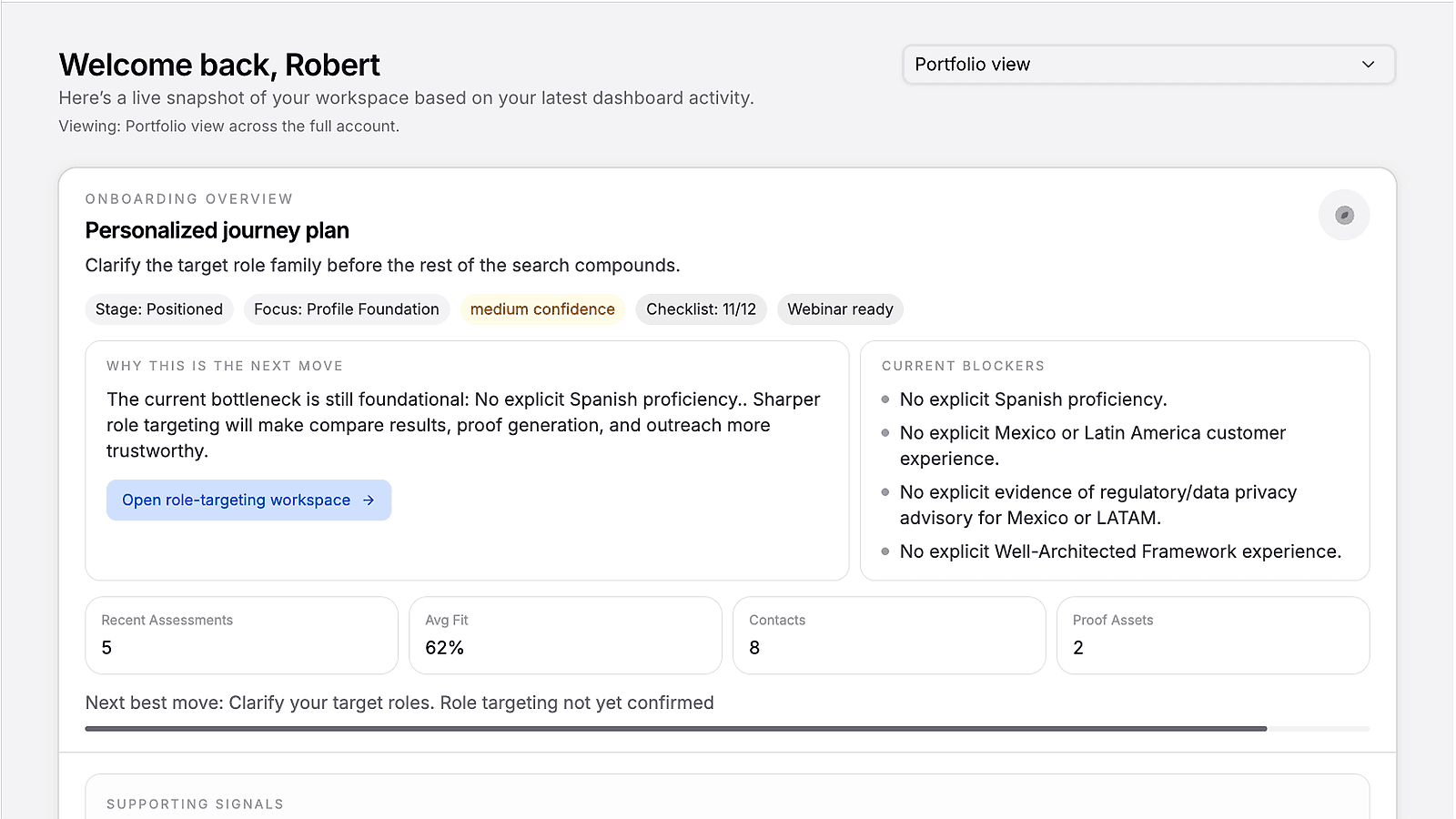
ResumeRavenPro’s product guidance call these changes search signals. The strongest candidates for dashboard influence include warm intros, referral replies, relevant listings at warm-path companies, proof artifacts published, Top 25 roles promoted into focus, interviews scheduled, and follow-ups sent. The same notes warn against counting every LinkedIn post, every code commit, or every low-value listing as progress.
That distinction matters. The best job seekers are not merely busy. They are creating signal.
Signal 1: They build in public with relevance
Public proof is strongest when it attaches to a role, company, domain, or problem the candidate wants to be known for. A generic post is weak. A proof brief, build update, market memo, or case study can be strong.
This aligns with external hiring trends. LinkedIn’s Future of Recruiting 2025 report says skills-based hiring is gaining steam and that talent teams increasingly care about accurate assessment of candidate skills. A public artifact gives another person something to assess before the formal assessment begins.
Signal 2: They rapidly expand the right part of the network
Network growth is not just adding connections. It is increasing relevant reach around target companies, role families, and communities of practice.
The weak-ties literature helps explain why this matters. The 2022 Science study summarized by Harvard Business School found that weaker ties can increase job mobility, though the effect depends on tie strength and context. For job seekers, that supports a practical habit: review the outer ring, but do not treat every weak tie as a referral.
Signal 3: They stand out from automated behavior
As employers and recruiters adopt AI, candidates who sound like every other AI-assisted application risk disappearing into the noise. LinkedIn’s report says generative AI is saving recruiting teams time and pushing recruiters toward more strategic work, including relationship building, communication, and reasoning. The candidate-side response should not be more generic automation. It should be clearer human judgment.
Signals that stand out include:
- specific outreach tied to shared context
- a concise proof artifact
- a thoughtful follow-up after a real interaction
- a portfolio note that explains decisions, not just deliverables
- an interview story the candidate can defend without reading from a script
Signal 4: They get reps and become fluent
Interview fluency is not memorization. It is repeated practice explaining the same evidence in different contexts. A candidate who can explain a project to a recruiter, a hiring manager, a peer, and a connector has made the evidence portable.
ResumeRavenPro’s candidate signal ledger concept supports this. Claims should have sources, confidence, reuse paths, and review status. That turns experience into reusable proof rather than one-off talking points.
“Fluency is what happens when proof has been rehearsed enough to become natural.”
Signal 5: They cross-pollinate opportunities
The strongest searches start to compound. A conversation reveals a related company. A proof brief works for two adjacent roles. A contact points to an unposted opening. A listing suggests a project. A project creates a reason to reach out.
This is where ResumeRavenPro’s operating-system framing matters. The product is designed to keep resumes, fit assessments, contacts, job listings, files, agent conversations, and workflow history in the same journey. The more those views connect, the more likely one action can improve the next.
Sources
- LinkedIn Future of Recruiting 2025: https://business.linkedin.com/hire/resources/future-of-recruiting
- Harvard Business School summary of Rajkumar et al., “A Causal Test of the Strength of Weak Ties,” Science, 2022: https://www.hbs.edu/faculty/Pages/item.aspx?num=62963
- ResumeRavenPro product and support documentation were used to verify product capability descriptions.